Spotify AI Tag

2026

Speculative Work

Music streaming platforms, like Spotify, are increasingly being flooded by AI generated music. Users want transparency.

Role: UX/UI Designer

Length: 1.5 Months

Team: Solo Project

Introduction

For this project, I was asked to design a new feature for an existing application– while adhering to its existing branding, style, and feel. I picked Spotify, and using the real life anecdotes of friends and family and Spotify's own community board, I decided to address an increasingly growing problem with music streaming platforms: transparency around AI generated content. To decide what solution would best address this issue, I researched the problem space and then conducted my own user interviews and competitive analysis. With that data, I was able to verify that users not only had strong feelings about AI generated music being available on Spotify, but that they had very strong negative feelings about the music not being clearly labeled and differentiated. Working within a one month timeline, I created, tested, and iterated on my ideas and ended up with the concept for an AI tag– which I then tested with users before building the final prototype.

Introduction

For this project, I was asked to design a new feature for an existing application– while adhering to its existing branding, style, and feel. I picked Spotify, and using the real life anecdotes of friends and family and Spotify's own community board, I decided to address an increasingly growing problem with music streaming platforms: transparency around AI generated content. To decide what solution would best address this issue, I researched the problem space and then conducted my own user interviews and competitive analysis. With that data, I was able to verify that users not only had strong feelings about AI generated music being available on Spotify, but that they had very strong negative feelings about the music not being clearly labeled and differentiated. Working within a one month timeline, I created, tested, and iterated on my ideas and ended up with the concept for an AI tag– which I then tested with users before building the final prototype.

What is the problem that needs to be solved?

Unlike typical music production, AI music can be generated so quickly and in such volume, that is beginning to bury real artists beneath it all.

The issue isn’t just that the AI music exists, it’s that it is often indistinguishable - and more important not visibly differentiated - from the music on the platform made by humans. This is especially prevalent for lyricless music, like “lowfi beats”.

According to a study run by Deezer, a competing streaming platform,

97% couldn’t tell the difference between fully AI-generated music and human-made music in a blind test”, 52% of people “felt uncomfortable with not being able to tell the difference between AI and human-made music”, and a whopping “80% agree that 100% AI-generated music should be clearly labeled to listeners”.

Not only does this problem have major ethical implications (copyright issues for the artists whose music was used to train the AI models, threatening the livelihood of artists, etc), it suggests a significant issue in transparency between the user and the product (in this case, Spotify).

What is the problem that needs to be solved?

Unlike typical music production, AI music can be generated so quickly and in such volume, that is beginning to bury real artists beneath it all.

The issue isn’t just that the AI music exists, it’s that it is often indistinguishable - and more important not visibly differentiated - from the music on the platform made by humans. This is especially prevalent for lyricless music, like “lowfi beats”.

According to a study run by Deezer, a competing streaming platform,

97% couldn’t tell the difference between fully AI-generated music and human-made music in a blind test”, 52% of people “felt uncomfortable with not being able to tell the difference between AI and human-made music”, and a whopping “80% agree that 100% AI-generated music should be clearly labeled to listeners”.

Not only does this problem have major ethical implications (copyright issues for the artists whose music was used to train the AI models, threatening the livelihood of artists, etc), it suggests a significant issue in transparency between the user and the product (in this case, Spotify).

  • What's the best solution? Let's find out together.

    What's the best solution? Let's find out together.

Research


In order to determine the best possible solution, I employed the following methodologies:
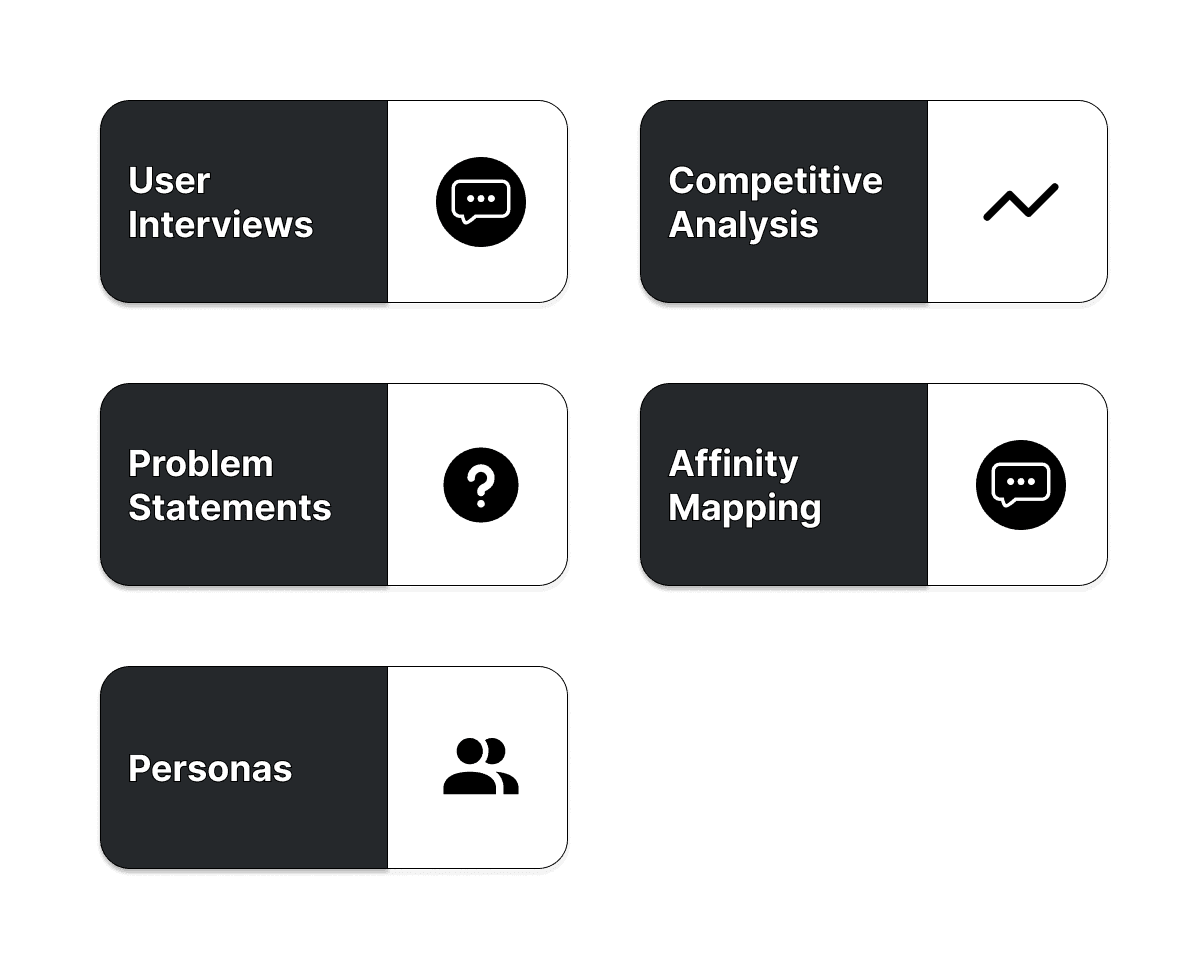
  1. Competitive Analysis

  2. User Interviews

  3. Problem Statements

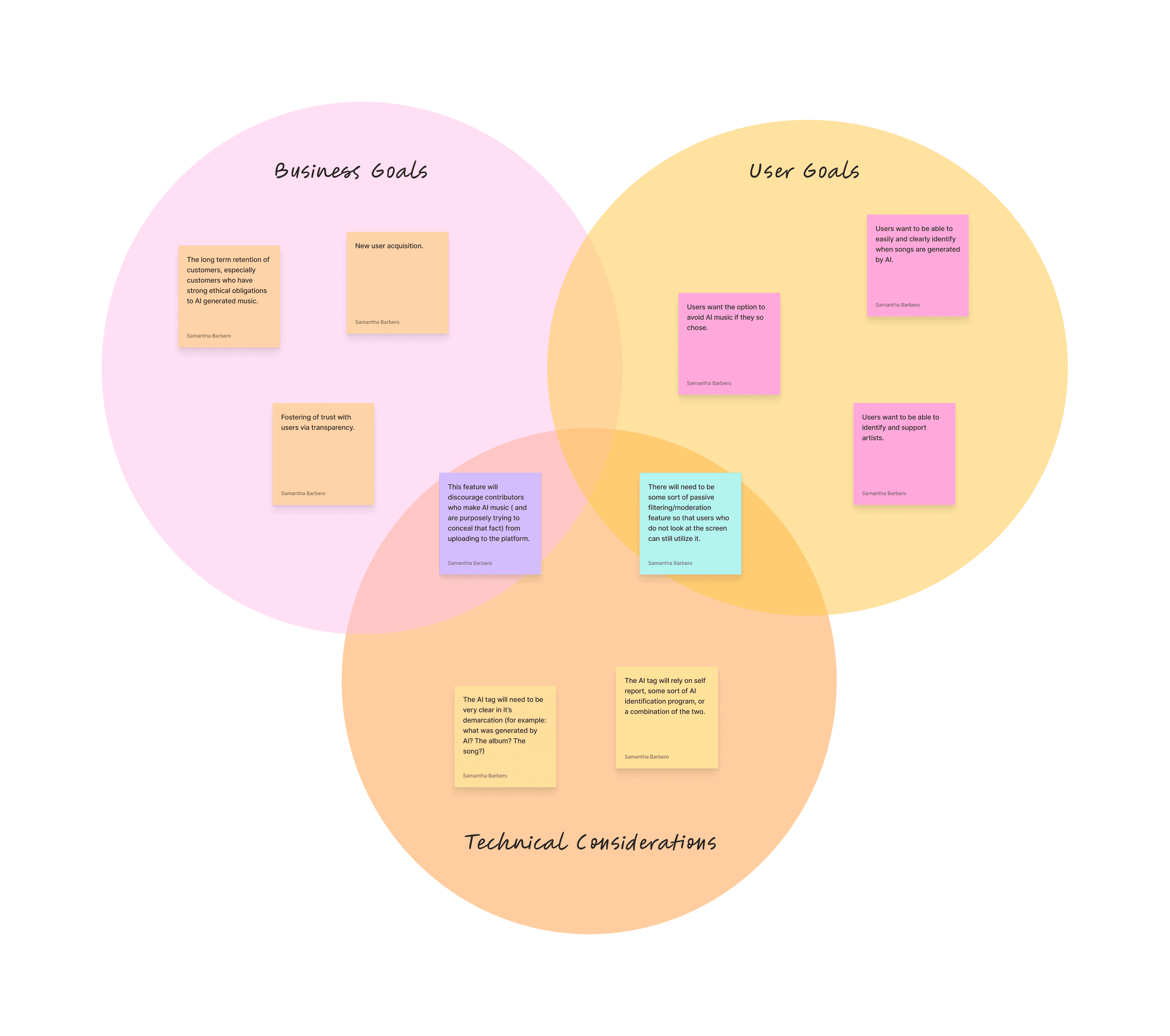
  4. Affinity Mapping

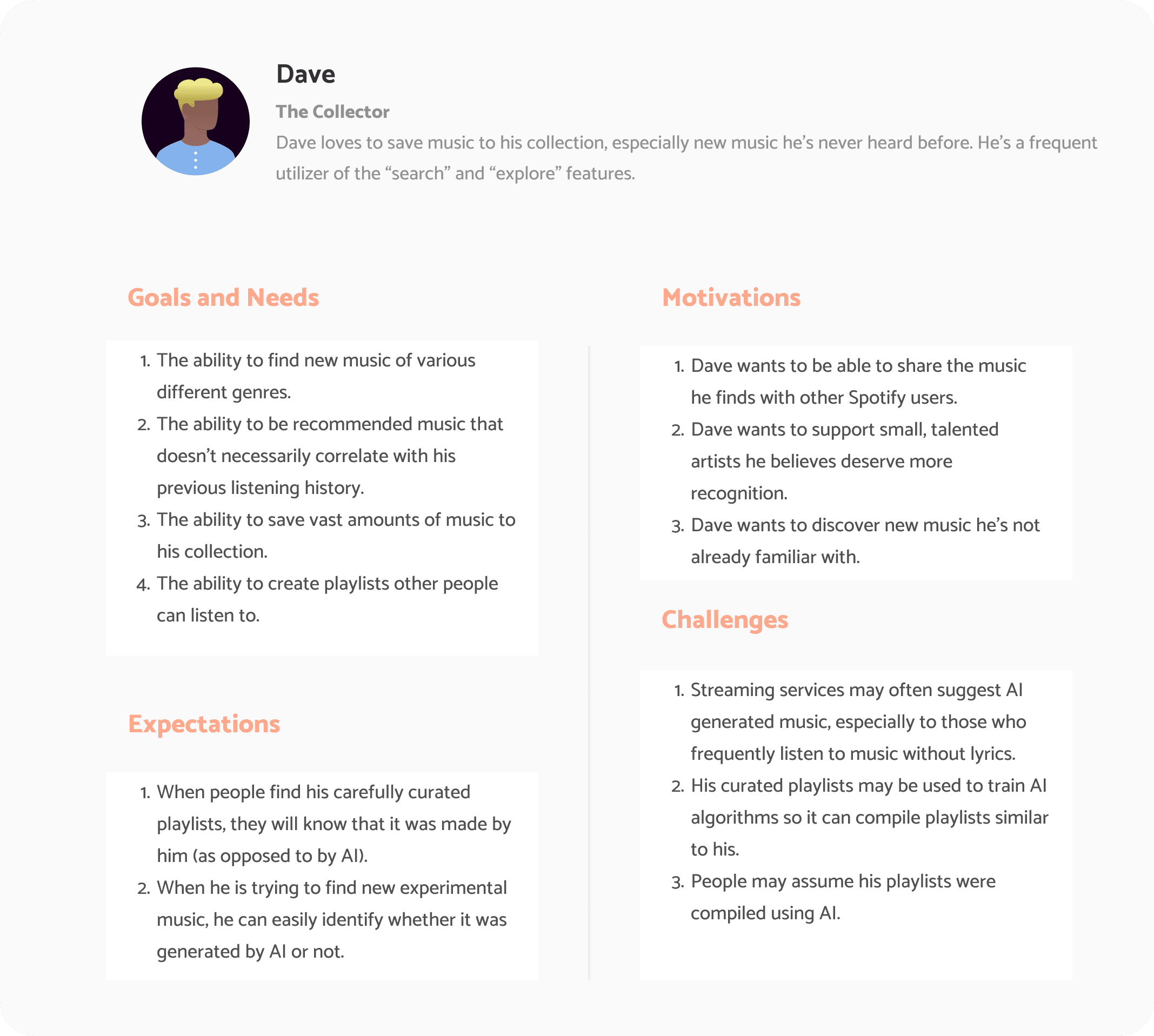
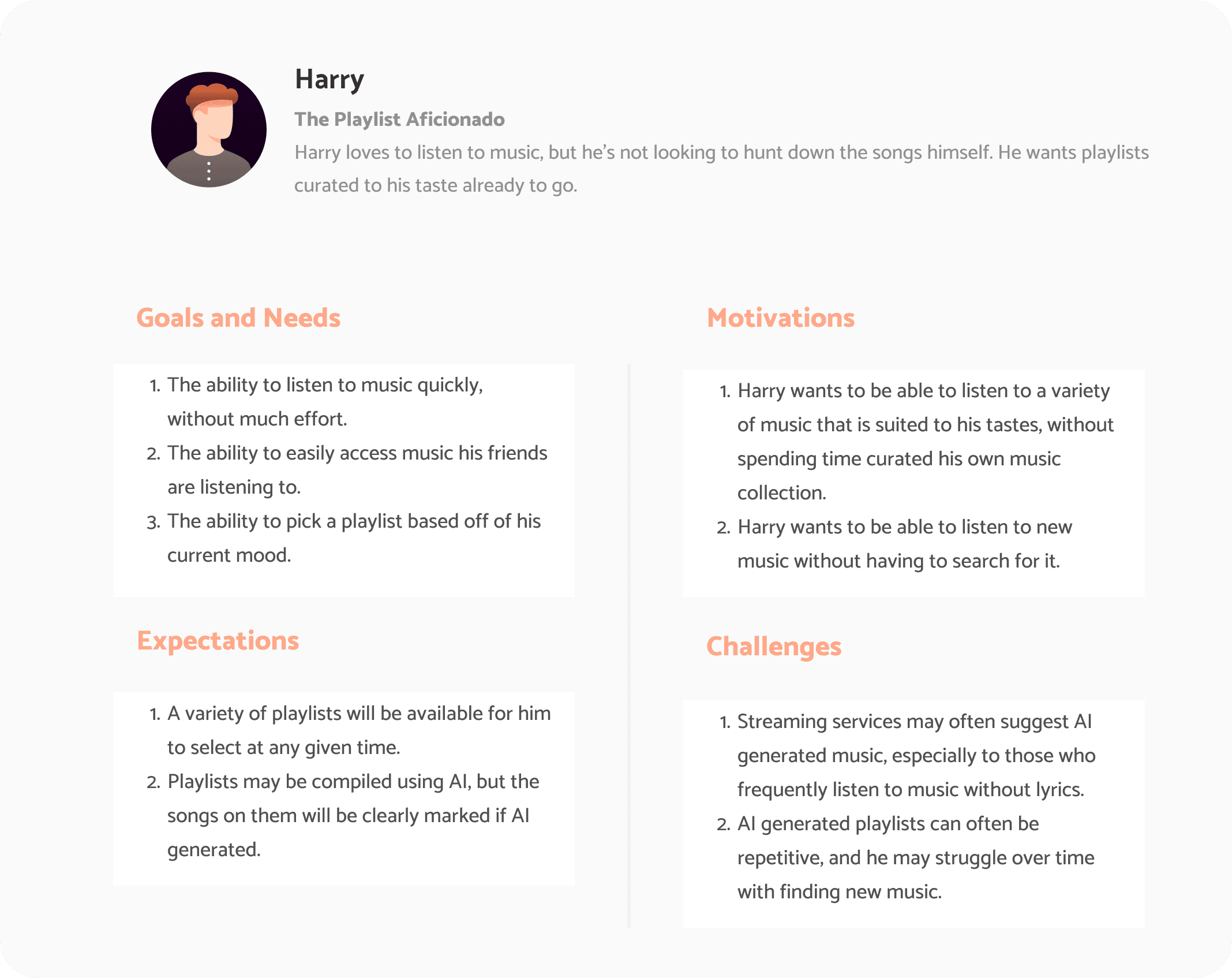
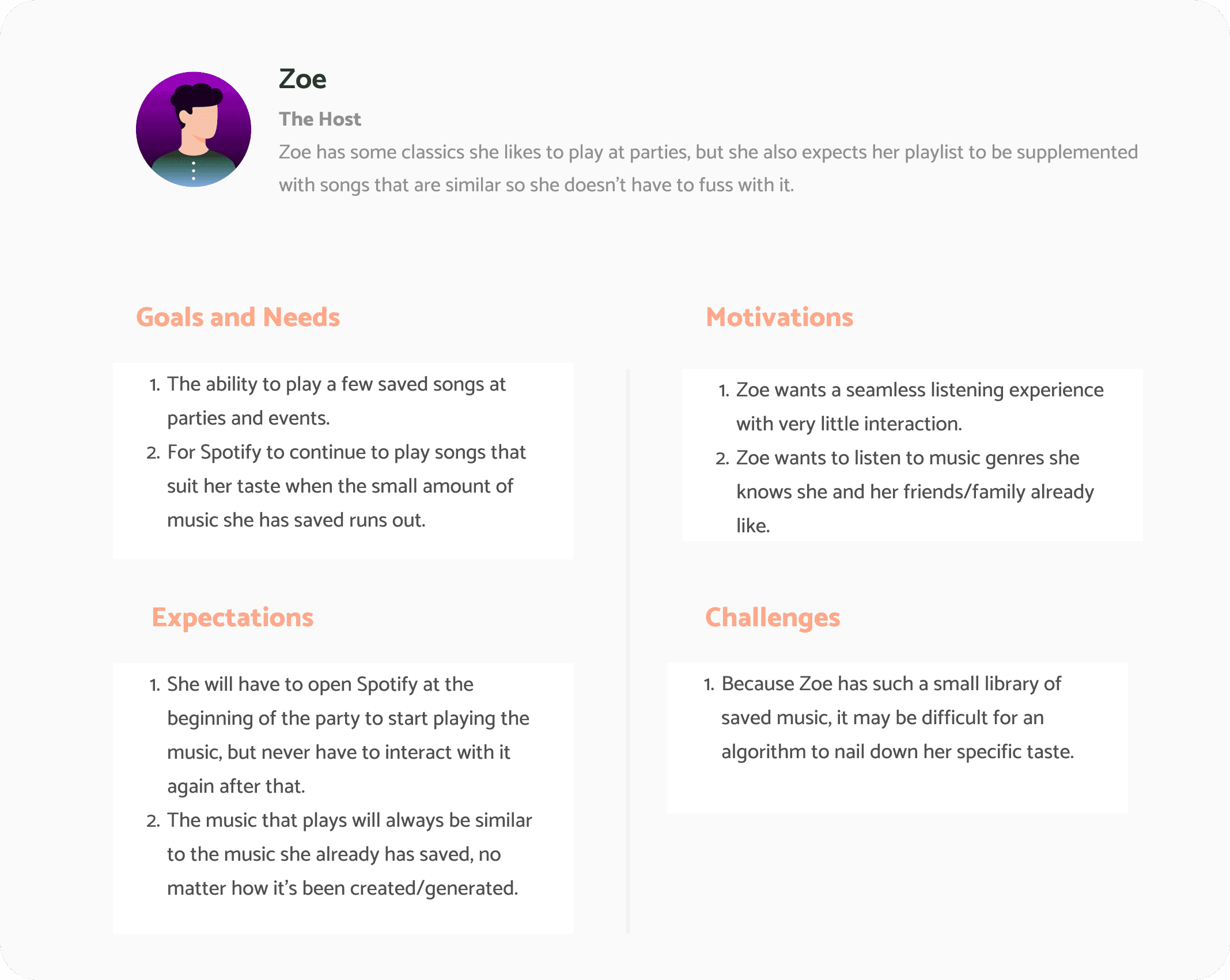
  5. Personas

Key findings and user identification


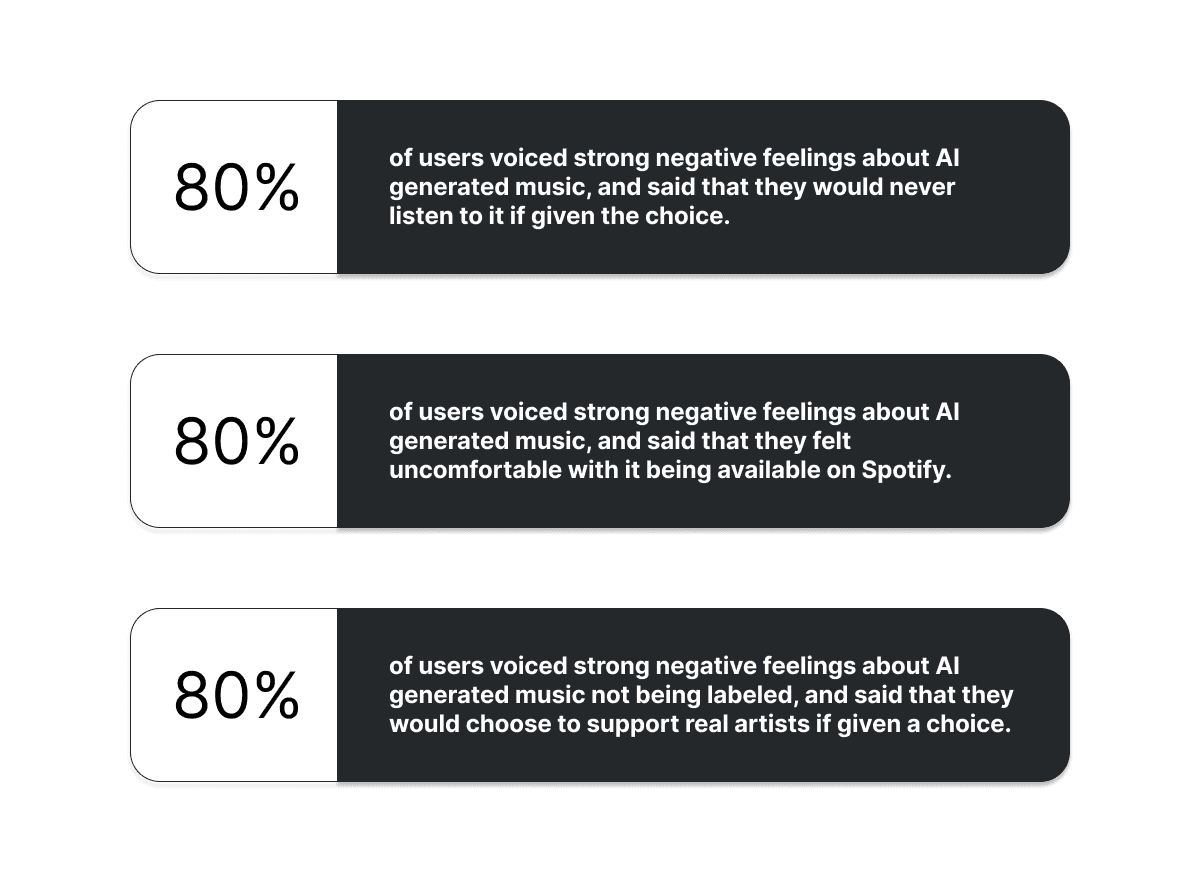
Most users were distressed by the idea that AI music wasn't clearly differentiated from human music. People want to be able to choose to support artists.

  1. 80% of users voiced strong negative feelings about AI generated music, and said that they would never listen to it if given the choice.

  2. 80% of users voiced strong negative feelings about AI generated music, and said that they felt uncomfortable with it being available on Spotify.

  3. 80% users voiced strong negative feelings about AI generated music not being labeled, and said that they would choose to support real artists if given a choice.


Problem Statement #1

Users have strong negative feelings towards AI generated music being available on music streaming platforms.

POV Statement

People who are using music streaming platforms like Spotify need to be able to avoid AI generated music completely if they so chose, otherwise they will feel deceived and distrustful.

HMW Questions

  1. How might we make it so users can avoid AI generated music altogether, even if they are passive listeners?


Problem Statement #2

Users have strong negative feelings towards AI generated music not being distinguishable from human made music.

POV Statement

People who are using music streaming platforms like Spotify need to be able to differentiate between AI generated music and human made music, otherwise they will feel disempowered and distrustful.

HMW Questions

  1. How might we make it so that people can identify whether or not music is generated by AI or a human?

  2. How might we make it so that people can identify whether or not a playlist is compiled by AI or a human?
Ideation - what am I hoping to achieve with the feature?

Now that I had identified the problem space, and the potential users, it was time to set some goals and figure out what the solution would look like.


This is what I came up with:


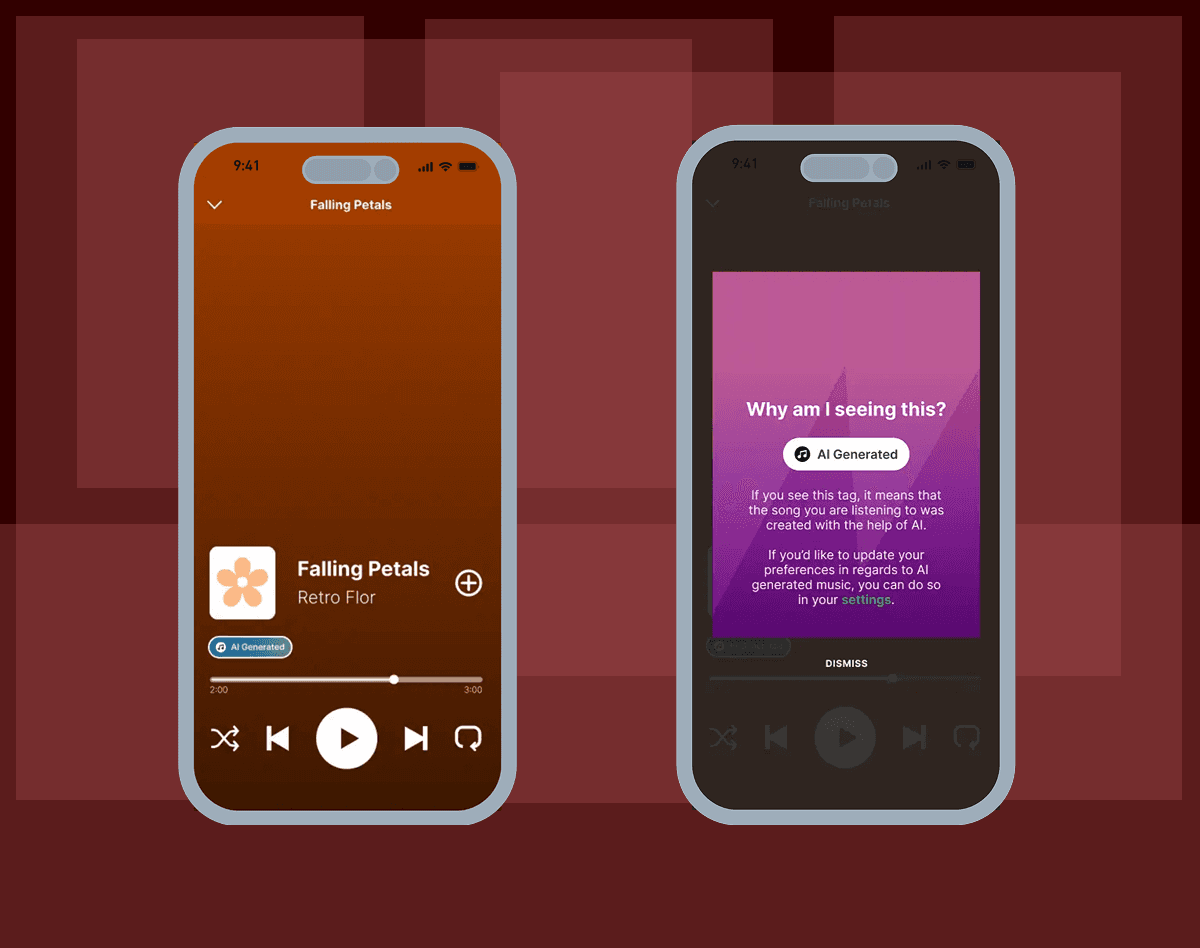
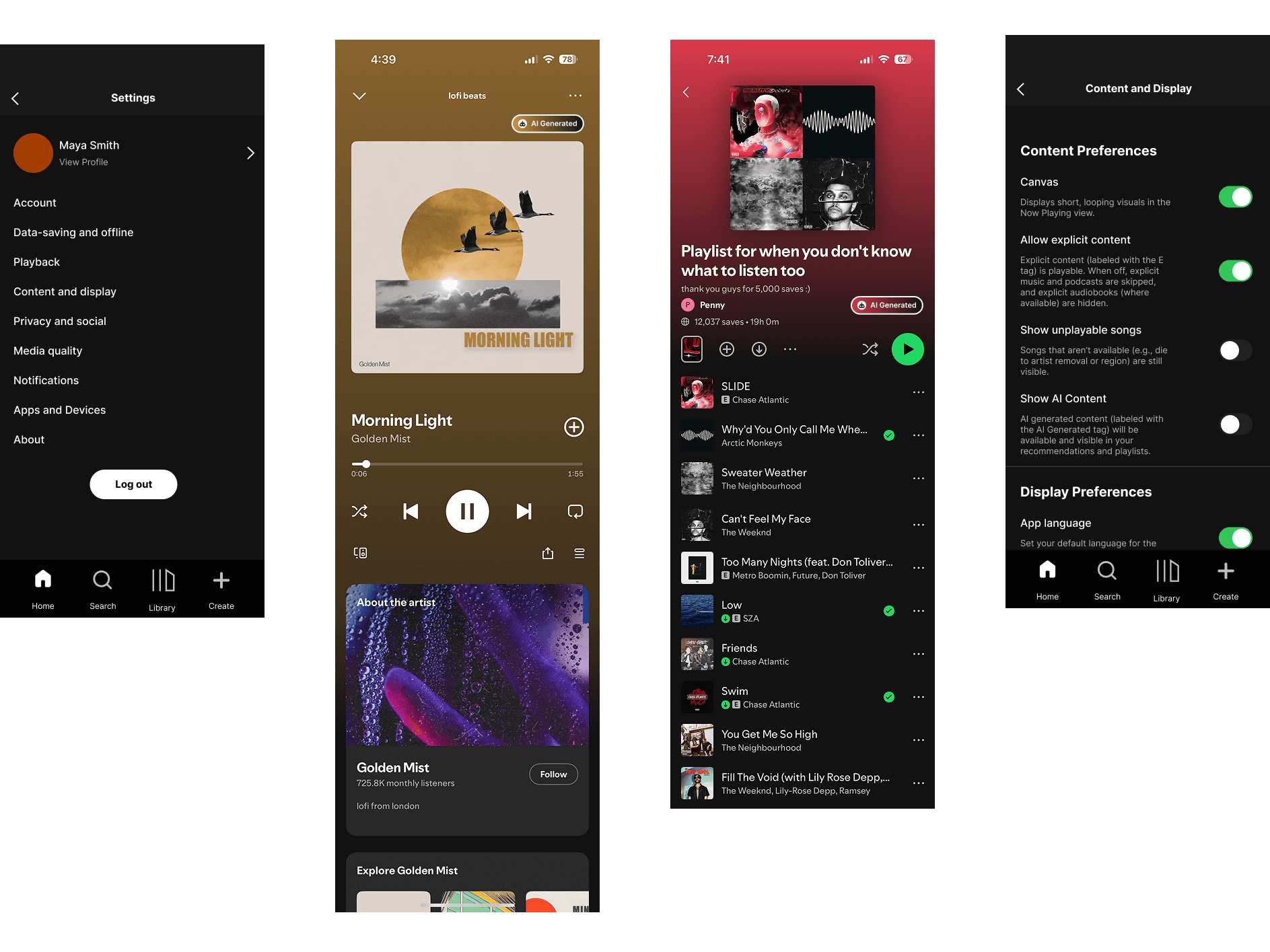
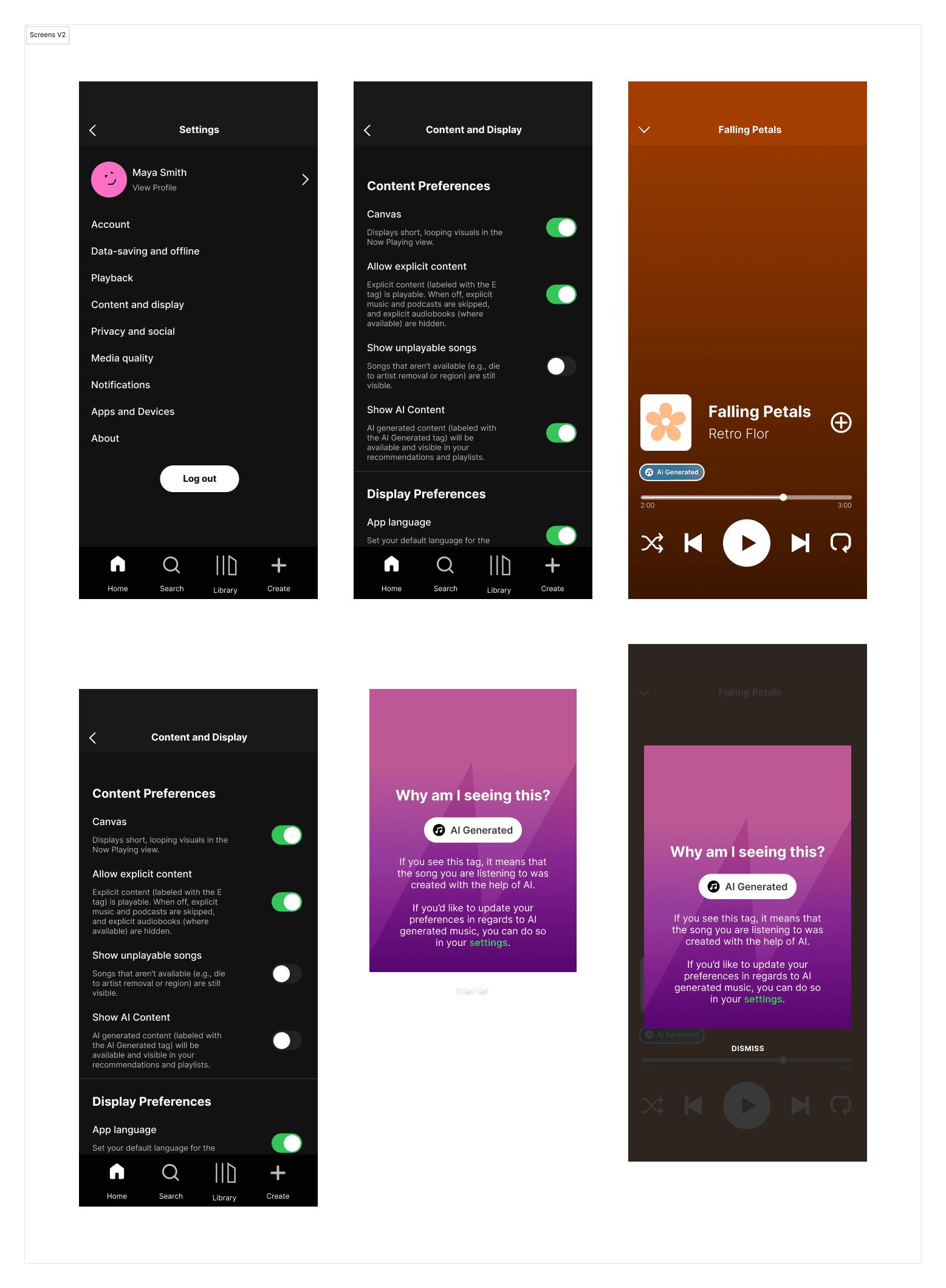
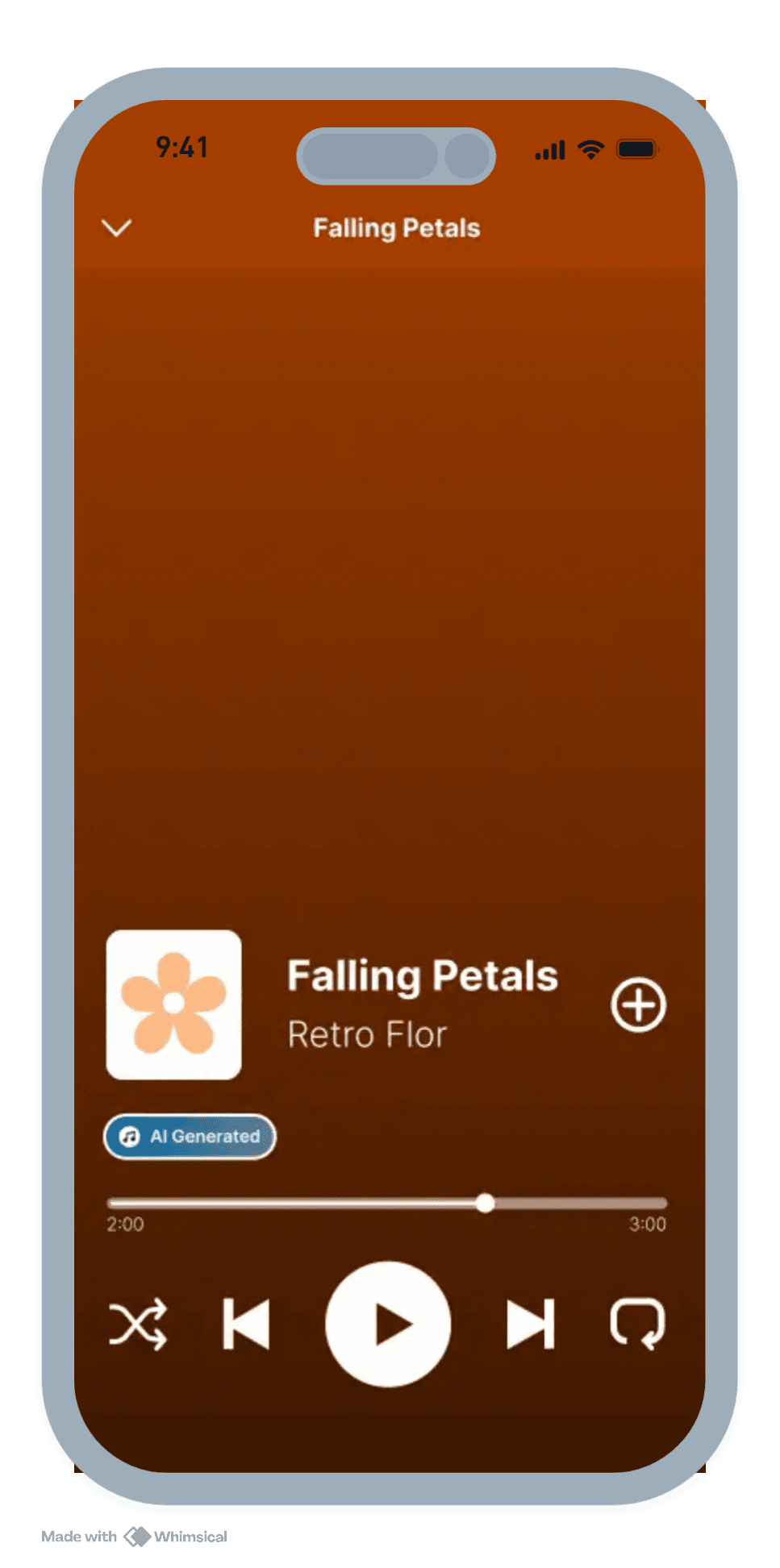
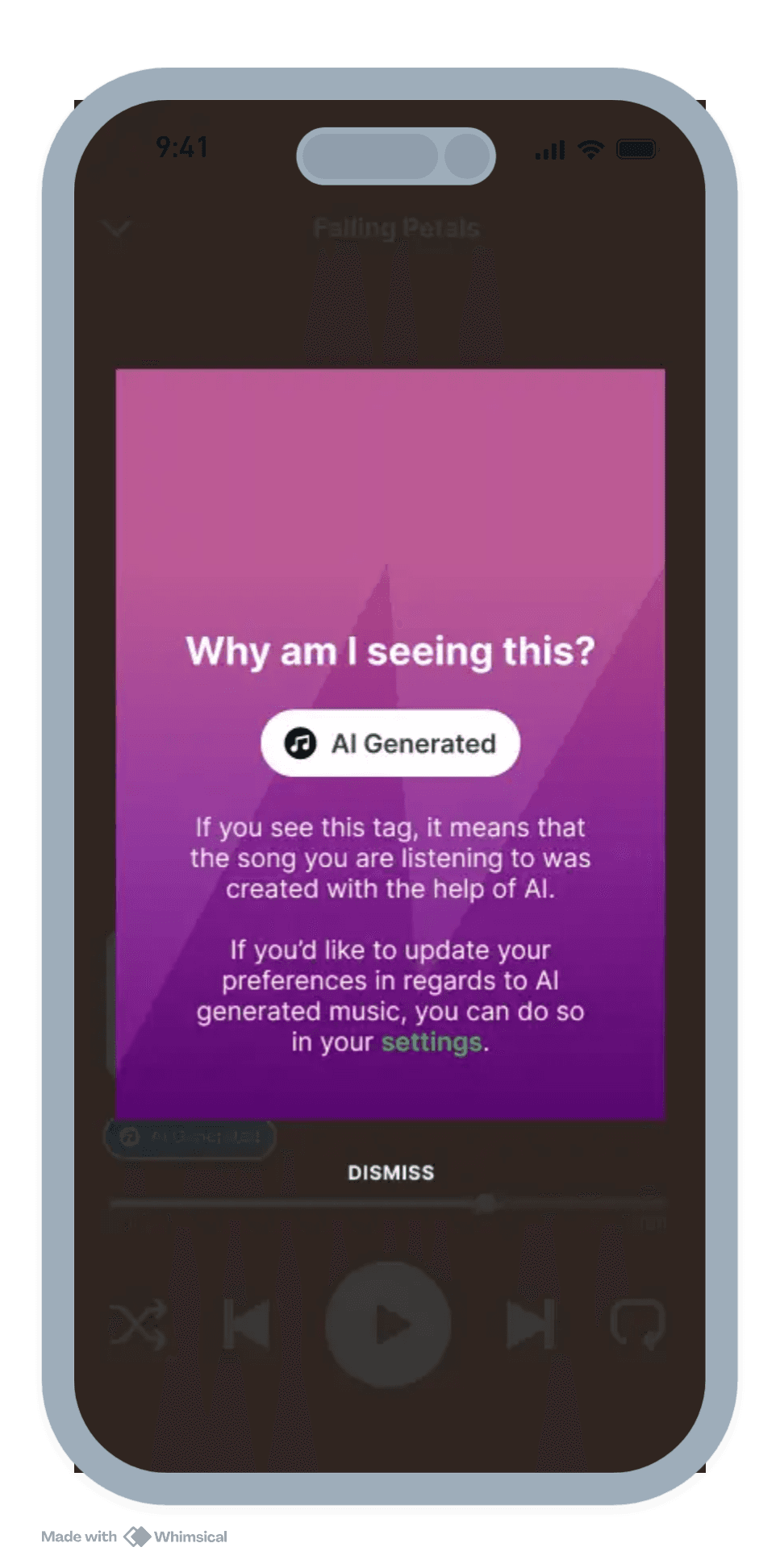
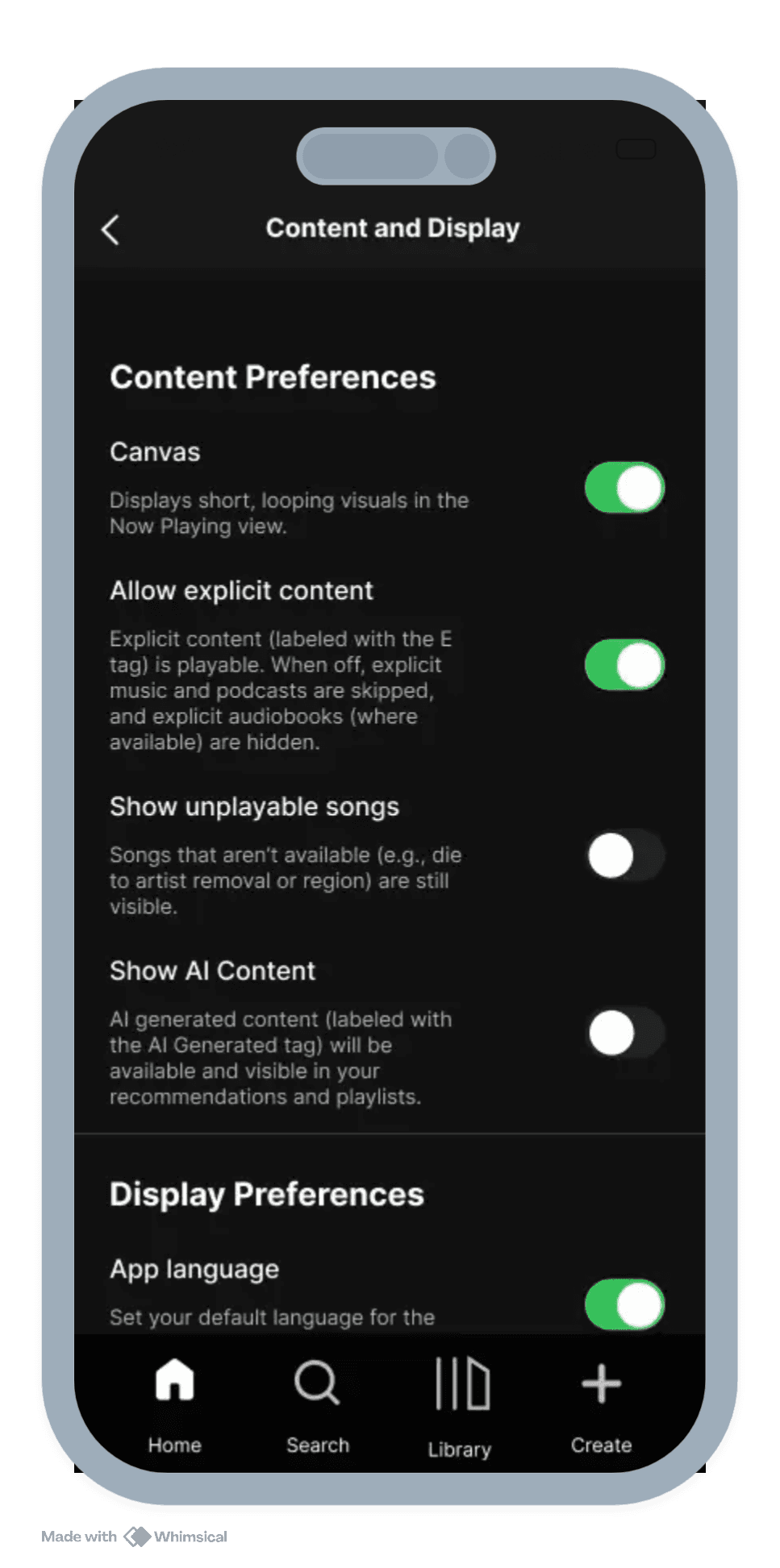
A feature that tags AI generated music within the Spotify platform, along with a setting that allows for users to opt out of getting AI generated music recommended to them.

Ideation - what am I hoping to achieve with the feature?

Now that I had identified the problem space, and the potential users, it was time to set some goals and figure out what the solution would look like.


This is what I came up with:


A feature that tags AI generated music within the Spotify platform, along with a setting that allows for users to opt out of getting AI generated music recommended to them.

  • Halfway! What do you think so far?

    Halfway! What do you think so far?

  • Halfway done! Hope you like it so far.

    Halfway done! Hope you like it so far.

Wireframing and Prototyping

Now it was time to figure out how users would physically interact with the app.

In order to help the product materialize, I utilized the following methodologies:

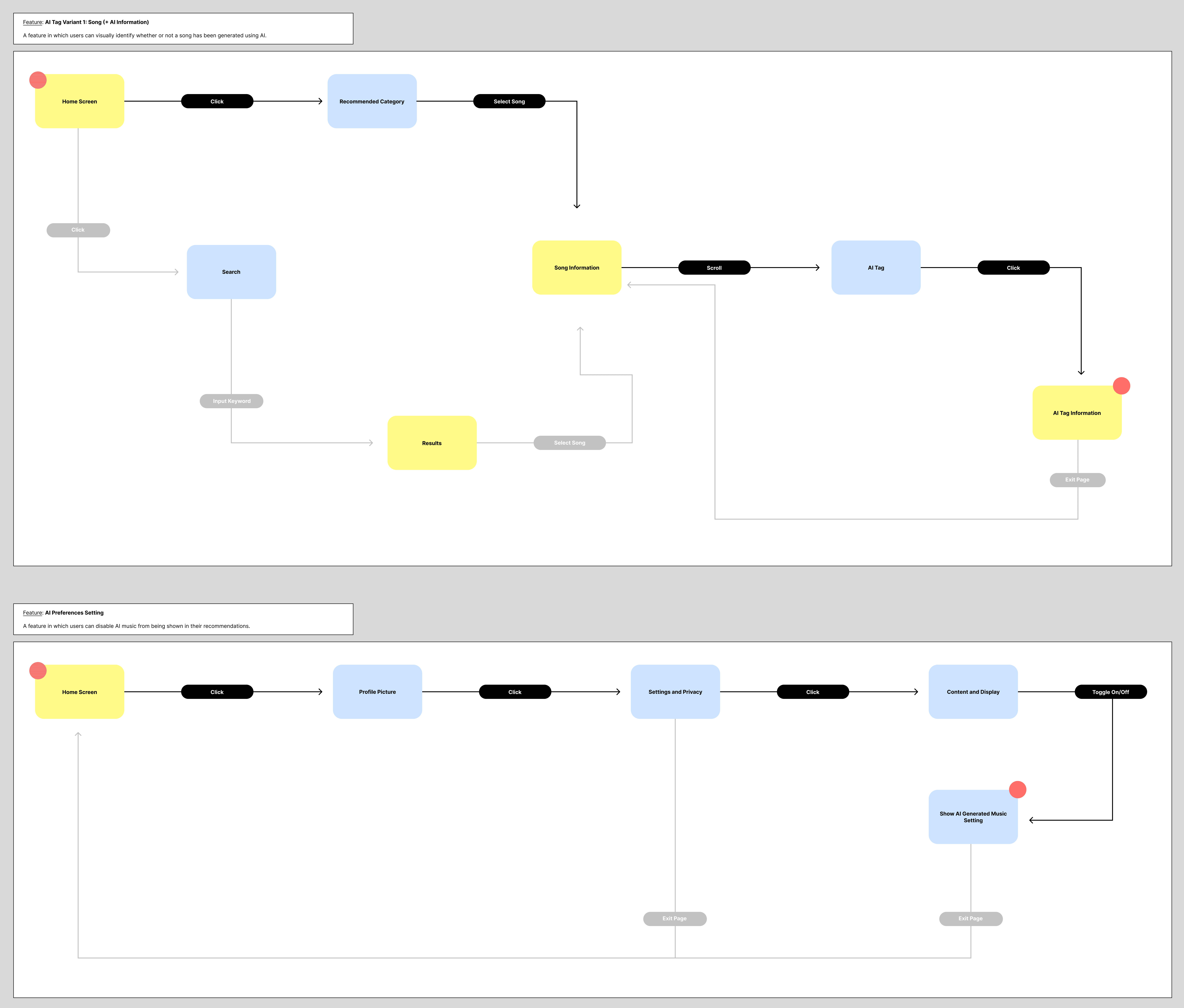
  1. User Flows

  2. Task Flows

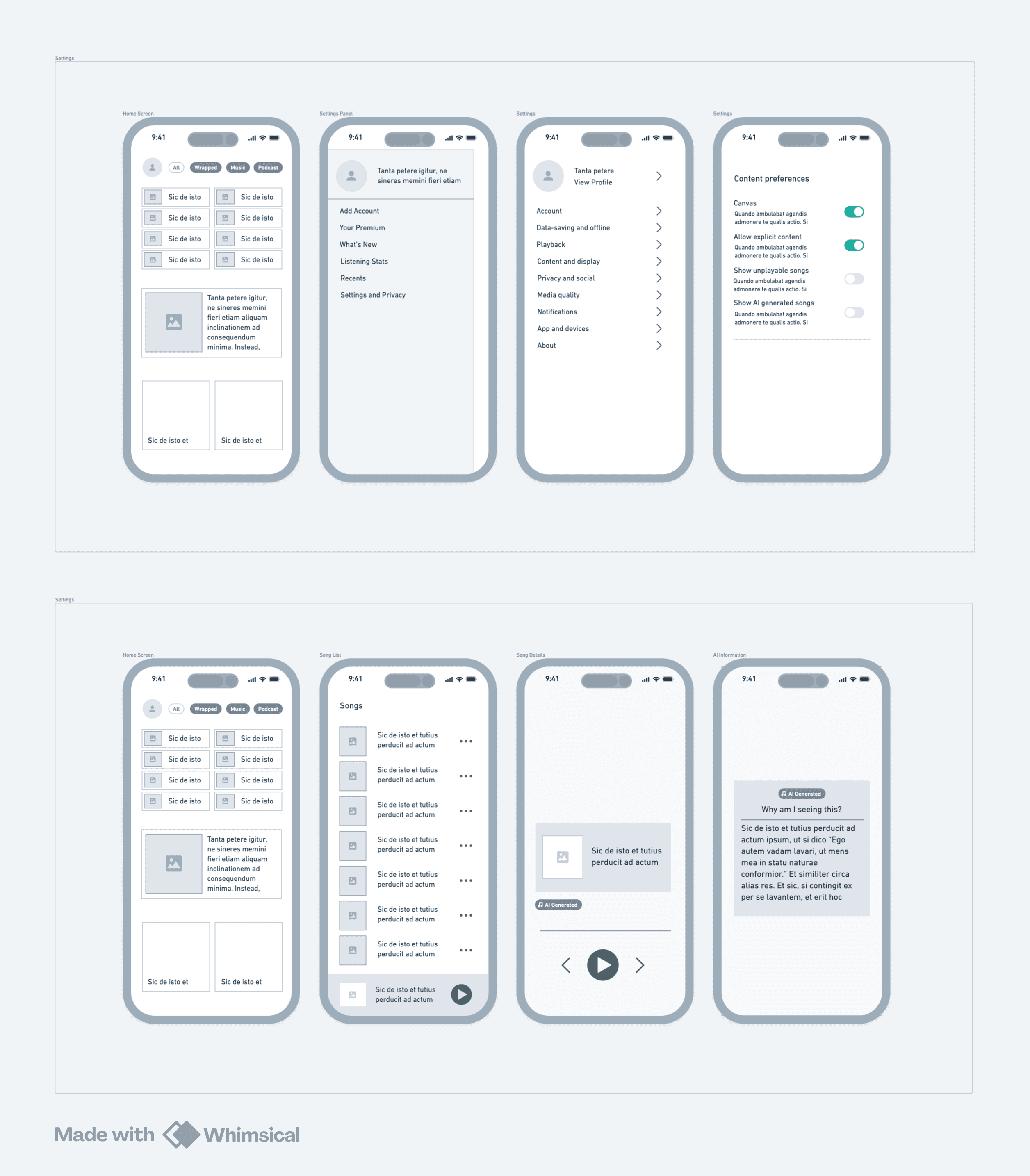
  3. Low Fidelity to High Fidelity Wireframes

  4. Interactive Prototyping

Wireframing and Prototyping

Now it was time to figure out how users would physically interact with the app.

In order to help the product materialize, I utilized the following methodologies:

  1. User Flows

  2. Task Flows

  3. Low Fidelity to High Fidelity Wireframes

  4. Interactive Prototyping

User Testing

Now it was time to ensure that the product was working as intended. Did it actually solve the problem I wanted it to?

I prototyped the High Fidelity Mockups in Figma and asked 6 different users to complete a series of tasks.

What did they think? What would I have to change to make this the ideal solution to our problem? Here were the key findings:
  1. All users found the AI tag to be a useful feature.

  2. Most users noted that it made them feel like Spotify was being more transparent.

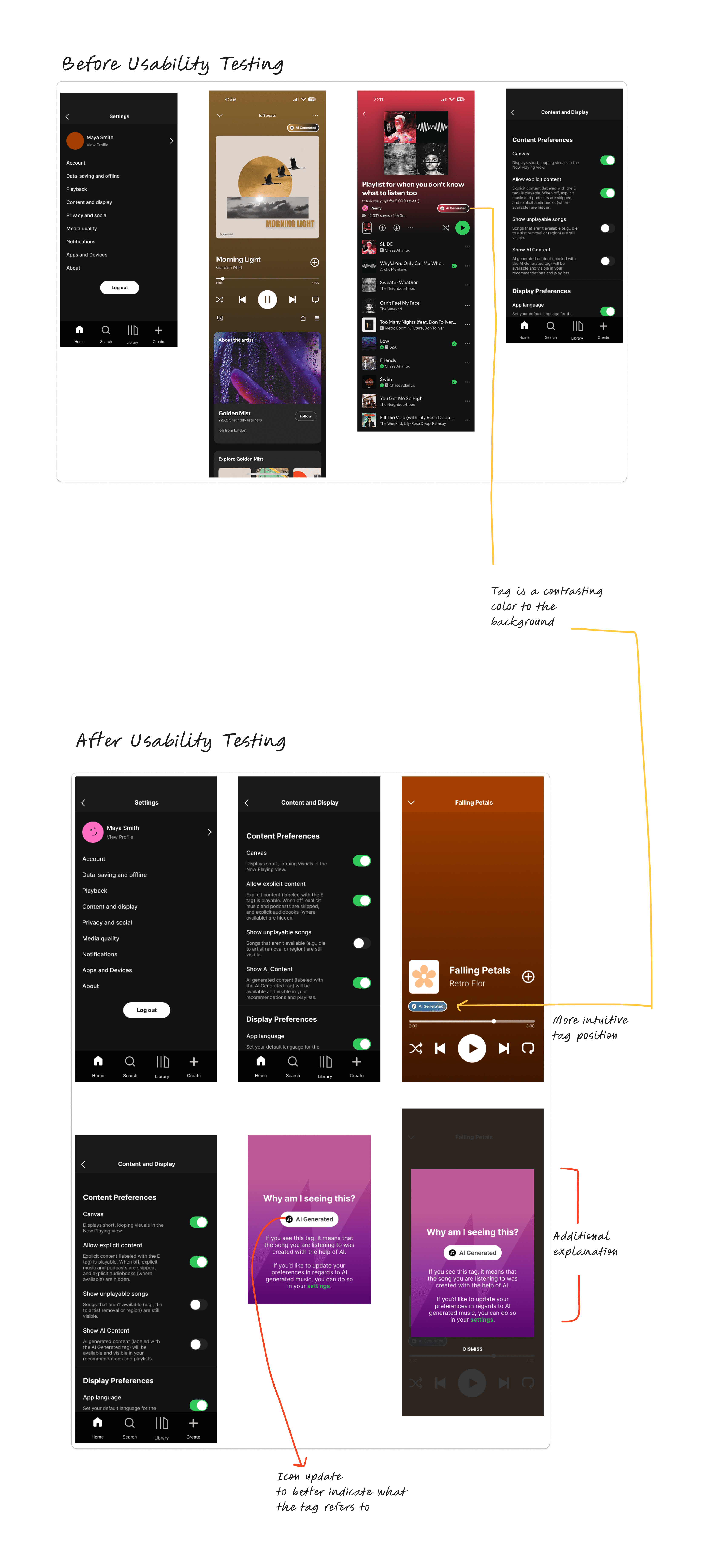
  3. Some users found the context of the AI tag to be unclear.

    1. For example: Was the tag indicating that the song was generated by AI? Or was it saying that the album art was generated by AI?

  4. Most users didn’t notice the AI tag if it was a color that was similar to other colors on the screen.

User Testing

Now it was time to ensure that the product was working as intended. Did it actually solve the problem I wanted it to?

I prototyped the High Fidelity Mockups in Figma and asked 6 different users to complete a series of tasks.

What did they think? What would I have to change to make this the ideal solution to our problem? Here were the key findings:

  1. All users found the AI tag to be a useful feature.

  2. Most users noted that it made them feel like Spotify was being more transparent.

  3. Some users found the context of the AI tag to be unclear.

    1. For example: Was the tag indicating that the song was generated by AI? Or was it saying that the album art was generated by AI?

  4. Most users didn’t notice the AI tag if it was a color that was similar to other colors on the screen.

Finalizing the Design

Now all there was left to do was to put all of the pieces together!


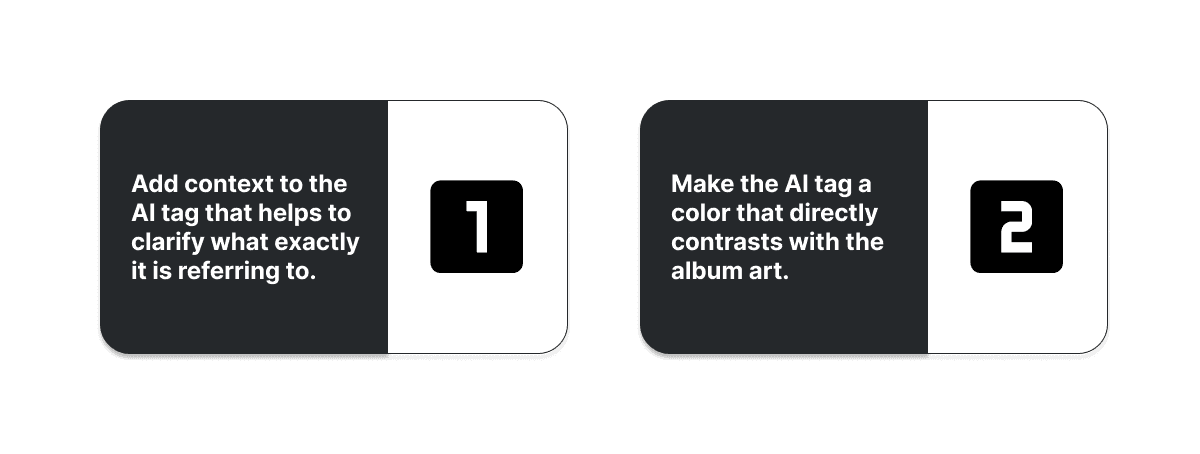
Opportunities and Prioritization:

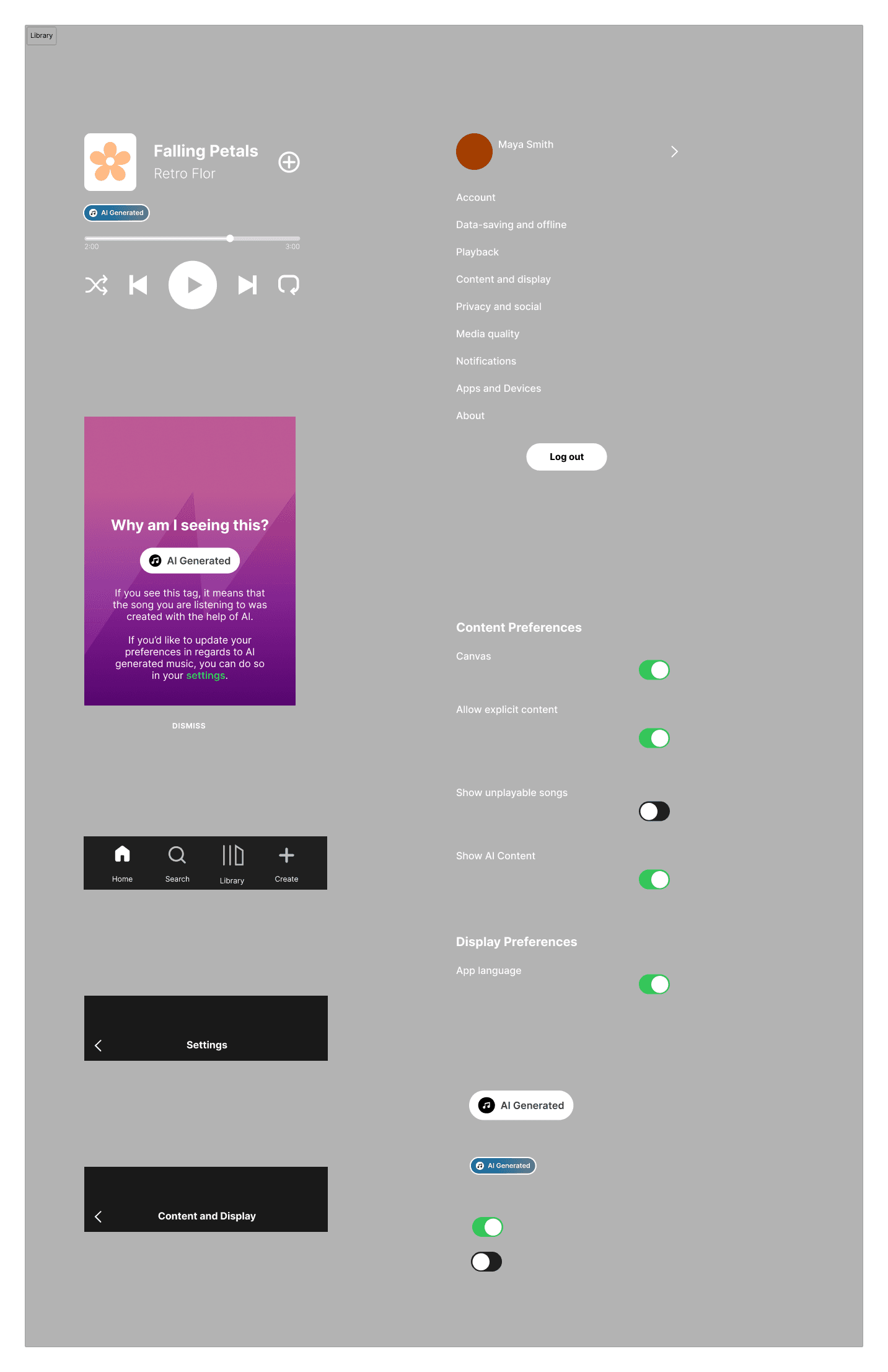
  1. Add context to the AI tag that helps to clarify what exactly it is referring to.

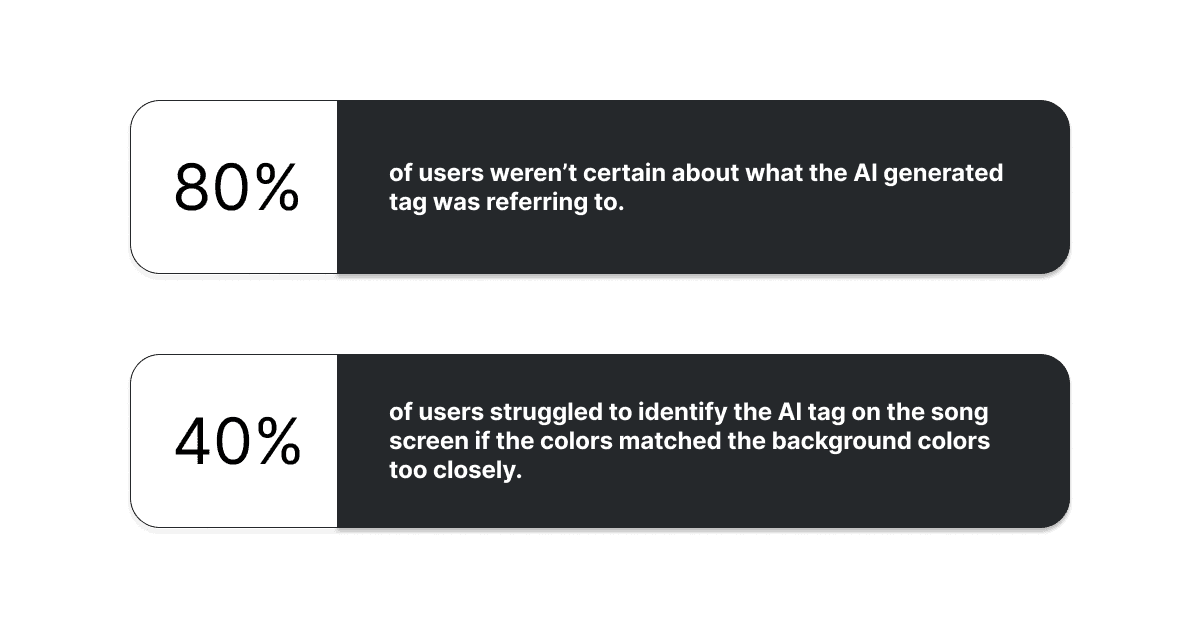
    1. 80% of users weren’t 100% sure about what on the page was AI generated

  2. Make the AI tag a color that directly contrasts with the album art.

    1. 40% of users struggled to identify the AI tag on the song screen if the colors matched the background colors too closely.


Finalizing the Design

Now all there was left to do was to put all of the pieces together!


Opportunities and Prioritization:

  1. Add context to the AI tag that helps to clarify what exactly it is referring to.

    1. 80% of users weren’t 100% sure about what on the page was AI generated

  2. Make the AI tag a color that directly contrasts with the album art.

    1. 40% of users struggled to identify the AI tag on the song screen if the colors matched the background colors too closely.


In Conclusion

Users have strong feelings about AI music in general, and they value transparency above all else. I believe a feature like this would greatly increase user satisfaction.
In Conclusion

Users have strong feelings about AI music in general, and they value transparency above all else. I believe a feature like this would greatly increase user satisfaction.
  • You made it! Thanks for reading. Bathroom break?

    You made it! Thanks for reading. Bathroom break?

©2026 Samantha Barbero

©2026 Samantha Barbero

©2026 Samantha Barbero